A permanent web address
One address that keeps working when your website is redesigned, your intranet is replaced or the original download link dies. Cite it in a report, a tender, a certificate or a court bundle.
Public record deposit
RecordMark fixes a document at a point in time and makes that fixable in public. Every record gets a permanent web address, a QR code, and a published fingerprint of the exact file, so anyone can check a copy years later. Optional AI writing and plagiarism reports can be attached to a record when you want to evidence how the text was produced. Screening is in a closed pilot and is not yet open to all depositors.
Enter an ID such as RM-2026-XXXXXXXXXX.
Free, no account needed, for anyone.
Point in time
Five things every record carries, whether or not the file itself is published, and two options you can add.
One address that keeps working when your website is redesigned, your intranet is replaced or the original download link dies. Cite it in a report, a tender, a certificate or a court bundle.
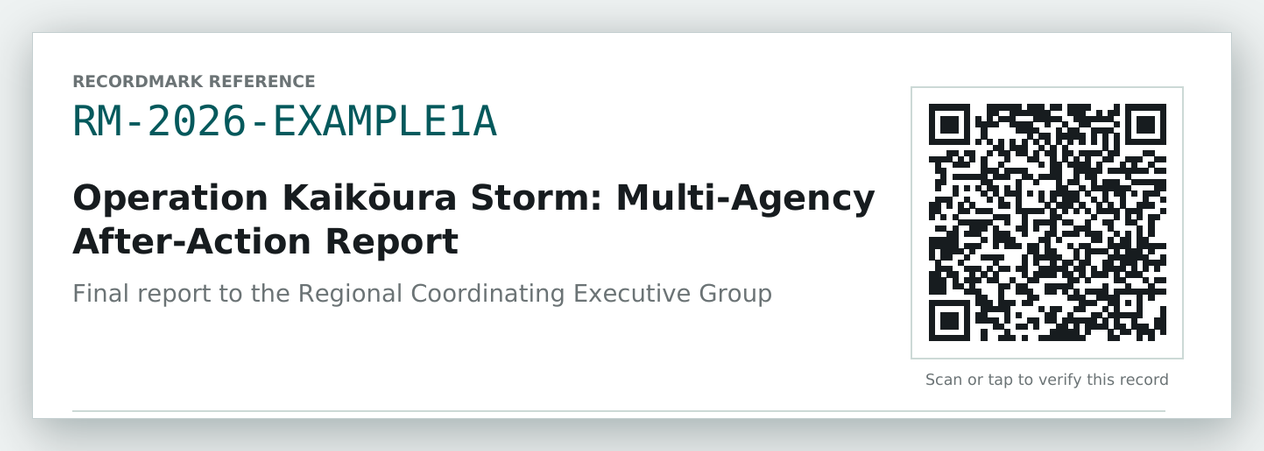
Each deposit certificate carries a QR code and a printed link to the public verification page. A reader holding the paper can confirm the record in seconds, without being told where to look.
A SHA-256 digest of the exact bytes of the file, shown openly. Anyone holding a copy can prove it is identical to the deposited one, using free tools, without our permission and without trusting us.
The deposit date is recorded by us rather than asserted by you. Replacing the document adds a version; it does not erase the earlier one. A change stays visible as a change.
Every record publishes an RSS feed beside its web address. Give that address to anyone who should follow the document and their reader tells them when it changes. No account, no mailing list, nothing for you to send.
You set the day and time the details become public and the day the document becomes available, in a time zone you choose, and release happens by itself. Nothing about the deposit itself is delayed.
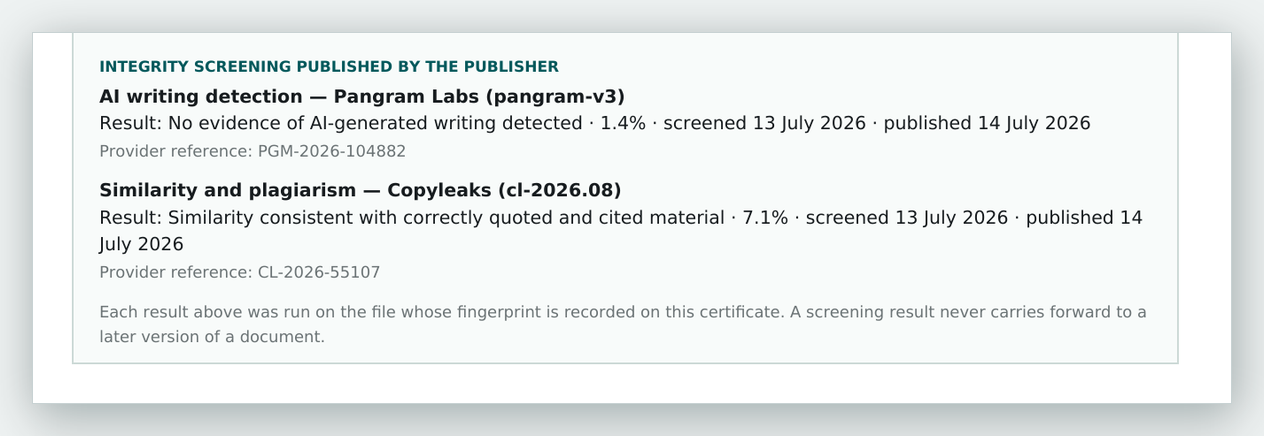
You may attach AI writing detection, and similarity checking against other sources, to the exact file you deposited. Never required, never automatic, and published only if you choose.
Public by default, on your terms
Records are public. Whether the file is downloadable is your decision, and you can change it later.
The file is available to anyone. Filename, format and size are shown publicly.
Signed-in users request access with a reason. You grant or decline each request.
Descriptive details and fingerprints only. The record stays verifiable; the file is not served.
Optional
Never required, never automatic, and never published unless you choose to publish.
An indication of whether the text shows signs of machine generation, reported with the provider, the model and the figure, so a reader can weigh it rather than take it on faith.
Text matching against other sources, priced in addition to AI writing detection. Useful where correct quotation and citation are themselves part of the claim.
A report belongs to the file it examined. Deposit a new version and it is screened separately, so a result can never appear to vouch for a document it never saw.
What a reader receives
Every record produces a certificate page that is added in front of the document. It states what was deposited, when, by whom, and with what fingerprint.
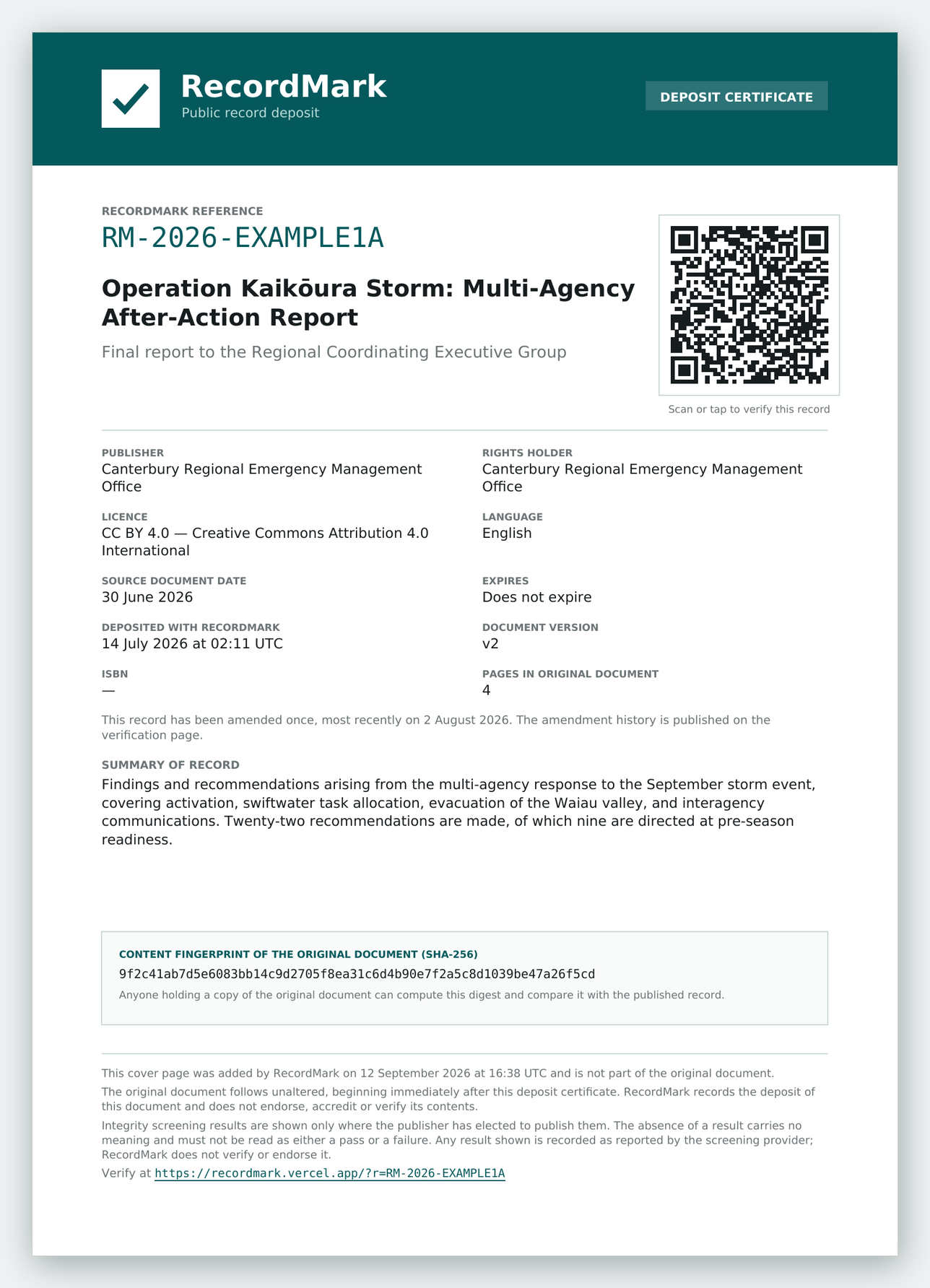
After-action reports, standards and doctrine, expert statements, safety alerts, research outputs, governance papers.
Public verification
Verification shows public record information only. Owner identity, payment data and moderation history are never disclosed.
Public directory
Returns records their publisher has chosen to list publicly. Unlisted records remain verifiable by exact reference. To find everything one organisation holds, search its .
Publisher area
Creating a draft reserves your permanent RecordMark reference. Nothing is public yet.
Publisher dashboard
Checking…
A coupon covers the deposit fee only. Integrity screening is charged separately unless the coupon states otherwise.
Your activity
Tell us what RecordMark should do that it does not do yet. We read every one. Suggestions are sent to us and are never shown to other users — your wording stays between you and us.
Organisations
Find an organisation by its registration number, or set one up so that records belong to the organisation rather than to whoever was signed in.
Search a registration number (for example CC12345 for a New Zealand registered charity), a RecordMark organisation reference, or a name. Only organisations whose registration a person here has checked against the official register appear in these results.
Anyone may set up an organisation. Registered status — charity, company, public body — is a separate step that we check by hand. Until it is checked, nothing about the registration is shown publicly.
Transactional email is not switched on during the closed beta, so an owner gives you a ten-character code. It must be entered by the person whose email address the invitation was sent to, and it expires after fourteen days.
Public concerns
Reports are linked to the exact RecordMark reference. This is not an emergency service.
What we do with a report, what to include, and the statutory processes we follow for copyright, harmful digital communications, privacy and court orders are set out in Complaints and takedown. For a court order or suppression matter, email info@ipsqa.com with "URGENT — court order" in the subject line.
Legal
Version 2026-09-13.4, last updated 13 September 2026. RecordMark is operated by IPSQA Ltd, a New Zealand limited company, company number 6789833, NZBN 9429046694799. These terms apply to the closed beta service.
Version 2026-09-13.4. RecordMark is a deposit and verification service. It records that a document existed in a stated form on a stated date, and publishes the descriptive information the depositor supplies. It is not a registry of merit.
RecordMark is operated by IPSQA Ltd, a New Zealand limited company incorporated on 3 April 2018, trading as IPSQA — the International Public Safety Qualifications Authority.
In these terms, "we" and "us" mean IPSQA Ltd, and "you" means the account holder.
You must be at least 16 years old to hold an account. You must give accurate account details, keep your password secure, and you are responsible for anything done through your account. Where you open an account for an organisation, you confirm you are authorised to accept these terms on its behalf, and the organisation is bound by them.
RecordMark issues a permanent reference for a deposited document, stores the document, calculates and publishes a SHA-256 fingerprint of its exact contents, and provides a public verification page. RecordMark does not endorse, accredit, peer review, fact-check or verify the contents of any deposited document, and does not confirm the accuracy of the descriptive information supplied by the depositor. A RecordMark reference is not a legal registration, a notarisation, a copyright registration, an accreditation or a finding about the quality or truth of the document. Nothing on this service is legal, professional or safety advice.
By depositing a document you confirm that you hold, or are authorised by the rights holder to grant, the rights necessary to deposit it, to store it with us and our providers, to make it available on the access basis you select, and — where you ask for integrity screening — to send its text to our screening provider; that the descriptive information you supply is accurate; and that the document does not infringe any third party's rights, breach any confidentiality or privacy obligation, contain personal information you are not entitled to publish, or contain unlawful material. You remain responsible for the content of your document at all times.
You must not deposit, and must not publish descriptive information containing:
If you are unsure whether a document may be deposited, deposit it as closed so that only the reference and fingerprint are public, or ask us first.
Where you generate a deposit certificate page, RecordMark creates a distribution copy consisting of one RecordMark certificate page followed by your original document, unaltered. Your uploaded file is never modified, and the published fingerprint of the original document does not change. The certificate page confirms deposit only.
Descriptive information may be corrected by the depositor. Every correction to a published record is logged with its date, the reason given and the fields changed, and that log is published on the record. Replacing the document itself creates a new version; earlier versions and their fingerprints are retained. Withdrawing a record removes public access to the document but does not delete the deposit history, because the integrity of the record depends on it.
You choose whether the document is openly downloadable, available on request, or closed. Where you choose "by request", requests are passed to you and you decide. Descriptive information, the reference and the fingerprint remain publicly visible for all published records regardless of file access.
You may set a record to be released to the public at times you choose. An embargo delays what the public can see; it does not delay the deposit. The reference, the deposit date, the fingerprint and the certificate date are all fixed when you deposit, so an embargoed record proves as much about the date of your document as one published immediately.
An embargo has two release times, both in a time zone you choose and recorded in it: the time the details become public, and the time the document becomes available. They may be the same. During the embargo you choose one of two positions. By default the record's existence is acknowledged — anyone with the reference sees that a deposit exists, its deposit date and its release date, and nothing else, which is what lets you cite the reference before release. Alternatively you may hide the record completely, in which case the reference does not resolve for anyone until the details time and no one can confirm from outside that the deposit exists.
Release happens automatically when the time arrives; it is not a manual step and does not depend on any scheduled task. You may bring a release time forward, or end an embargo, at any time. Putting a release time back is not something you can do yourself, because a release date that keeps moving is not an embargo; ask us and we will consider it and record the reason. Withdrawing a record takes precedence over an embargo. A legal hold does not extend an embargo, and where the law requires us to release or restrict a record earlier we will, and the fact of it is recorded on the record.
You may nominate up to five people to be told when a record is released. In doing so you confirm you may give us their address for that purpose. We use it only to send that notice, every notice says who nominated them and how to be removed, and the addresses are deleted 90 days after release. Notices cannot be sent while transactional email is disabled, and until it is enabled the nominations are held and nothing is sent.
An embargoed deposit may carry a charge in addition to the retention plan. The charge in force is shown before you set the embargo. While payments are disabled, any charge is recorded against the record and not collected, and where no fee has been set no charge arises.
Integrity screening is optional. Where you ask for it, the text of the document — not the file itself — is sent to our screening provider, Pangram Labs, Inc., in the United States, which returns an indication of whether the text appears to have been generated by an AI writing tool and, where similarity screening is selected, whether matching material exists online. Pre-Check works the same way on a document you have not yet deposited.
A screening result is a statistical indication produced by a third party, not a finding of fact and not a determination by IPSQA that a document is or is not authentic. A result belongs to one exact file and does not carry over to a new version. Results are private to you unless you choose to publish them on the record; where you publish one, the provider, the model and the date of the check are published beside it, and you may withdraw it, with the withdrawal logged. Where a result concerns a document you did not write, you are responsible for having the right to send its text for screening.
RecordMark is evidence that a document existed in a stated form on a stated date. It is not a system of record for legal, regulatory or archival compliance, and it is not a substitute for holding the document yourself. You can export a record at any time from your dashboard: the reference, the fingerprints, the descriptive information, the amendment history and any screening results, in a file you keep. Please keep both that export and the original document.
During closed beta the service is free. When fees apply, the fee, the currency and the storage period are stated before you commit, and any tax is shown at that point. A deposit fee pays for the record and for the storage period selected.
If a deposit cannot be completed, we refund it in full. Once a record is published and a certificate page issued, the fee is not refundable, because the work has been done — this does not affect any right you have under consumer law. If we discontinue RecordMark before a paid storage period ends, we will give at least 90 days' notice, keep exports available throughout, and refund a fair proportion of any prepaid unused period. A Pre-Check fee may be credited once against a later deposit on the terms set out on the Pricing page.
Anyone may report a record. Our procedure, the information a complaint should contain, the statutory processes we follow for copyright and for harmful digital communications, and our response times are set out under Complaints and takedown.
We may restrict, withdraw or remove a record, or suspend an account, where we reasonably consider the record unlawful, infringing, seriously misleading, or in breach of these terms. Where practicable the depositor will be told and given an opportunity to respond first; where we act first, we will tell the depositor as soon as possible afterwards. Urgent safety, privacy or legal risks may be acted on immediately.
The database and stored files are backed up automatically by our hosting provider. We do not guarantee that any particular document, version, certificate or record can be recovered, and a backup is not a substitute for your own copy or your own export.
RecordMark is in closed beta and is provided as is, without warranty of any kind. We do not promise uninterrupted availability.
Loss of your records. To the extent permitted by law, we are not liable for the loss, deletion or corruption of a deposited document, a version, a certificate page or descriptive information, however caused, beyond the limit below. Your export and your own copy of the document are not affected by anything that happens to our systems. A RecordMark reference and its fingerprints let you prove that a document you hold is the document that was deposited; they are not a substitute for holding that document.
To the maximum extent permitted by law, we are not liable for any indirect or consequential loss, or for loss of profit, reputation, opportunity, or anticipated savings. Our total liability to you, for everything taken together in any twelve-month period, is limited to the greater of the amount you paid us in that period and NZ$500.
Nothing in these terms limits rights under the New Zealand Consumer Guarantees Act 1993 or the Fair Trading Act 1986 that cannot lawfully be excluded, or the equivalent rights of a consumer under the mandatory law of their own country.
Where you deposit in trade. Where you acquire the service in trade and we are both in trade, we agree in writing that the Consumer Guarantees Act 1993 does not apply, under section 43(2) of that Act, and that sections 9, 12A and 13 of the Fair Trading Act 1986 do not apply as between us, under section 5D of that Act; both of us accept that it is fair and reasonable to agree that. This paragraph does not apply to an individual who deposits in their own right and not in trade.
If a third party brings a claim against us because of a document you deposited or descriptive information you supplied, you agree to meet the cost of dealing with that claim, including reasonable legal costs and any award or settlement. This applies only to claims arising from the content you deposited or published, a breach of clause 4 or clause 5, or a deposit made knowing you did not hold the rights to make it — for example infringement of someone else's copyright, publication of confidential or suppressed material, or personal information published without a lawful basis. It does not apply to anything caused by us, or to anything a consumer cannot lawfully be required to indemnify us for.
If such a claim arises we will tell you promptly, let you take part in how it is handled, follow your reasonable directions where we can, and not settle it without asking you first.
"RecordMark", the RecordMark logo, the certificate page design and the verification page are ours. Depositing a document gives you no right in them. You may reproduce a reference, a fingerprint, a verification link or a QR code freely. You must not remove or alter the RecordMark certificate page, the reference or the verification link from a distribution copy, or present a document as deposited when it is not.
If you are signed in you may send us a feature suggestion. Sending one is voluntary and free, and nothing you write in a suggestion is shown to any other user of the service.
By sending a suggestion you grant us a perpetual, worldwide, irrevocable, royalty-free and transferable licence to use, adapt and implement the idea in RecordMark or any other product, and you confirm that the suggestion is yours to give and does not disclose anyone else's confidential information. We are under no obligation to build it, to keep it confidential, to reply, to pay for it, or to credit you. We will credit you by name only if you tick the option asking us to, and you may withdraw that at any time by writing to us.
We may decline, hold, edit for our own records, merge or delete a suggestion. Suggestions are screened automatically against a word list; a suggestion that trips it is held for a person to read rather than discarded. Do not send confidential material, personal information about other people, or anything you are not free to disclose. Suggestions are not a route for complaints, takedown requests or access requests, which are dealt with under clauses 13 and 14.
You may set up an organisation account and deposit records in the organisation's name. In doing so you confirm you are authorised by that organisation to deposit the documents you deposit and to accept these terms on its behalf. Records deposited by an organisation belong to that organisation, not to the member who uploaded them, and remain with it if that member's access ends.
An organisation may claim a registered status — charity, company, public body or similar. We check the registration number against the official register by hand and, where we accept it, publish the number, the register consulted and the date of the check. That publication is a statement of what we checked and when. It is not an endorsement of the organisation, of its governance, or of anything it deposits, and it is not a representation that the registration remains current after the date shown. Anyone relying on it should check the register themselves; a link is provided for that purpose.
Where we have checked a registration number in advance we may issue a pre-approval code. A claim submitted with a matching code and number is accepted immediately on the strength of that earlier check, on the same terms as any other check. A code is issued for one registration number, may be limited in the number of times and the period in which it can be used, and may be withdrawn at any time before it is used.
A check carries a review date. When it passes, the organisation reverts to unverified, any reduced rate ceases to apply to new deposits, and the page shows the date of the last check. Records already deposited are not affected.
Where a reduced rate applies to a class of organisation, it applies only to that organisation's own records, is not transferable to another organisation or to a trading company, and ceases for new deposits when a check lapses or is withdrawn. If a claim is later found to be false or materially misleading we may recover the difference between what was paid and the standard rate, withdraw the checked status and close the account. We will not remove records already deposited on that basis alone, because the deposit record itself must remain reliable.
You must keep the organisation's details accurate. Changing the legal name of an organisation whose registration we have checked sends it back for checking, because the published statement names what we checked.
These terms may change as the service develops. Each version carries a version number. Where a change is material we will ask you to accept the new version when you next sign in, and we record which version you accepted and when. Continuing to use the service after a minor change means you accept it. Fees and storage periods already paid for are not changed retrospectively.
These terms are governed by New Zealand law and the New Zealand courts have non-exclusive jurisdiction. This does not affect any mandatory consumer protection in the country where you live.
Questions about these terms: info@ipsqa.com.
Version 2026-09-13.4. IPSQA Ltd (company number 6789833, NZBN 9429046694799), of Suite 13759, Level 1, 6 Johnsonville Road, Johnsonville, Wellington 6037, New Zealand, is the agency responsible for personal information collected through RecordMark, under the Privacy Act 2020 (New Zealand). Where the UK GDPR or EU GDPR applies, IPSQA Ltd acts as controller for that information.
Account information — your email address, a display name, and an encrypted password, held by our authentication provider. Deposit information — the documents you upload and the descriptive information you enter, including publisher and rights holder names. People you nominate — where you ask us to tell someone that an embargoed record has been released, the email address and any name you give us for that person. Integrity screening information — where you ask for screening, the text of the document, its fingerprint and word count, and the result returned by the provider. Access requests and messages — where you request a document or contact a publisher, your name, email address and the reason or message you write. Reports — where you report a record, your name, email address, organisation if given, and your description of the concern. Activity records — an append-only log of deposits, publications, amendments, downloads authorised, decisions on access requests, moderation actions and acceptances of these terms, with the acting account and a timestamp.
Where an organisation claims a registered status we collect the registration number, the name on the register, the role of the person claiming, any statement they give, and any evidence files they upload — for example a constitution, trust deed, letter of authority or register printout. We also record which register page we consulted and the date we consulted it.
Evidence files are held privately. They are visible only to our administrators, are never shown on a public page and are not served to other users. We hold them because a published statement that we checked a registration must be capable of being audited. They are purged seven years after the organisation closes its account, and the record that a check was made, by whom and on what date is kept. The registration number, the register and the date of the check are published on the organisation's page; the evidence behind them is not.
To operate the deposit and verification service and to charge for it — performance of our contract with you. To maintain a defensible audit trail so a record's history can be relied on, to run integrity screening you have asked for, to handle reports, complaints and takedown, and to prevent misuse — our legitimate interests in the integrity of an evidence register, balanced against your interests. To publish a screening result on a record — your choice to publish it. To send a release notice to someone a depositor nominated — our legitimate interests in giving effect to the depositor's instruction, on the depositor's confirmation that they may give us that address, and every notice tells the recipient who nominated them and how to be removed. To meet legal obligations, including tax and responding to lawful requests — legal obligation. Under the Privacy Act 2020 the same purposes apply under information privacy principles 1 to 3, 10 and 11. We do not sell personal information, use it for advertising, or make automated decisions about you; a screening result is information for you to interpret, not a decision we take.
Descriptive information about a published record is public, including title, summary, publisher and rights holder names, licence, dates, reference and fingerprints, and the amendment history — its dates, reasons and changed fields. Do not enter personal information into these fields unless you intend it to be public. Your account email address is never published. A screening result is published only if you choose to publish it. When you send an access request or an enquiry, your email address is disclosed to that publisher so they can reply; when you submit a report, your identity is disclosed only if you consent, where the law requires it, or where disclosure is necessary to address the report — including where the Harmful Digital Communications Act 2015 requires a complaint to be passed to the author.
We use third-party providers to run the service, each processing on our instructions. The register below is generated from our own records and states, for every provider, what it does, where it holds the information, the safeguard we rely on for the transfer, and whether the written processor agreement is yet in place. Where an agreement is still being obtained, it says so.
These providers store or process information outside New Zealand — the database and the deposited files are held in Singapore, and hosting, email, screening and payment providers operate from the United States, Ireland and other locations shown in the register. Where we transfer personal information overseas we do so under information privacy principle 12 of the Privacy Act 2020, and where the GDPR applies we rely on the European Commission's standard contractual clauses with the UK addendum where relevant. Those clauses take effect through each provider's data processing terms; the register states which of those agreements we have signed and which we are still obtaining, and we will not describe an agreement as in place before it is.
You may ask for a copy of the personal information we hold about you, ask us to correct it, export your records at any time from your dashboard, and withdraw a record you deposited. Where the GDPR applies you also have rights to restrict or object to processing, to portability, and to erasure.
Erasure and a published record. Because RecordMark exists to record that a document was deposited, we cannot delete the deposit history, the fingerprints or the audit log of a published record. We rely on our legitimate interest in the integrity of an evidence register and, where the GDPR applies, on Article 17(3)(b) and (e) — legal obligations and the establishment, exercise or defence of legal claims. What we will do is withdraw public access to the document, remove or redact descriptive information at your request, and remove your account identifiers, keeping only what the audit entry requires. If you are named in someone else's record and object to that, use the complaints procedure and we will assess it.
Requests: info@ipsqa.com, or by post to IPSQA Ltd, Suite 13759, Level 1, 6 Johnsonville Road, Johnsonville, Wellington 6037, New Zealand; we reply within 20 working days. If you are not satisfied, you may complain to the New Zealand Office of the Privacy Commissioner at privacy.org.nz, or to your local supervisory authority where the GDPR applies. Where a representative under Article 27 of the GDPR is appointed for the EU or the UK, their contact details will be published here.
If you send us a feature suggestion we hold the text you wrote, the category you chose, the date, your account email address, your display name, and whether you agreed to be contacted or credited. We use it to decide what to build and, where you allowed it, to contact you about it. The lawful basis is our legitimate interest in improving the service; you are free not to send one. Your wording is never shown to other users and never published. If you close your account, the text, your email address, your display name and any internal note are removed and only the category, dates and outcome remain, so we keep an accurate record of what was decided without keeping anything about you. You can ask for a copy of your suggestions or ask us to correct or delete them at any time.
RecordMark is not for children. Accounts are for people aged 16 or over, and we do not knowingly collect information from anyone younger.
Documents are held in private storage; only open-access files are served to the public, and then through short-lived signed links. Access is controlled row by row at database level, so a signed-in user can reach only their own records and the public directory. Passwords are stored hashed by our authentication provider and are never visible to us. Screening keys and other credentials are held server-side and are never exposed to a browser.
RecordMark sets no advertising or analytics cookies. Your browser stores a session token so you stay signed in, and a small offline cache so the site works with a poor connection.
Version 2026-09-14.1. RecordMark is designed to be append-only. Its value depends on a record's history remaining intact, so most information is retained rather than deleted. Under information privacy principle 9 of the Privacy Act 2020 we keep personal information no longer than is required for the purposes for which it may lawfully be used; for a deposit register that purpose — proving what was deposited, by whom and when — does not expire, and the schedule below states where it does.
Generated from the retention schedule we operate against. A row marked enforced automatically is carried out by a scheduled job that writes every action it takes to an internal retention log.
The schedule is set out in the paragraphs below.
Retained for as long as the record is published, and for the storage period stated on the deposit. Where a record is withdrawn, the file stops being served publicly but is retained so the deposit can still be evidenced. Superseded versions are retained with their own fingerprints.
Retained indefinitely. A RecordMark reference and its fingerprints are permanent, so that a QR code or citation printed today still resolves in the future. This is the purpose of the service and the basis on which the information is held.
Retained indefinitely, and not editable by depositors or by IPSQA Ltd staff through the service. Deleting an audit entry would defeat the purpose of holding it.
The text sent to the screening provider is not stored by us. The result, the fingerprint of the file checked, the word count, the provider and the model are retained with the record, and for a Pre-Check for 7 years, so that a published result and a charge can be accounted for afterwards. The free text around a screening — the provider's headline wording, the list of similarity sources, any error message and the name of the file submitted — is removed 90 days after the screening completes, automatically, leaving the verdict and the figures.
Retained for 7 years from the date of the decision or the closure of the report, then deleted, unless they relate to an unresolved complaint, an investigation, or a legal claim. Seven years reflects the six-year primary limitation period under the Limitation Act 2010 with a margin for late notification.
Retained while the account is open. If you close your account, your email address and display name are removed within 30 days, except where they form part of an audit entry, a report or an amendment history, which are retained as above.
The version of these documents you accepted, and when, is retained for as long as the account exists and for 7 years afterwards, so that the terms applying to a deposit can be established.
The database and stored files are backed up automatically by our hosting provider, on a rolling basis, and are used only to restore the service after failure or loss. We do not guarantee that any particular record can be recovered from a backup, and a backup is not a substitute for your own export.
RecordMark is at its permanent address, recordmark.app. Records issued under the earlier beta service address continue to resolve, and verification links and certificate pages now carry the permanent address. A certificate downloaded before the move still verifies: its reference and fingerprints are unchanged, and the earlier address redirects.
Version 2026-09-13.2. If a record infringes your rights, harms you, or should not be public, tell us and we will act. Use the Report issue button on the record, or email info@ipsqa.com with the RecordMark reference in the subject line. This procedure is available to anyone, whether or not you hold an account.
Your full name and contact details; the RecordMark reference and, if you can, a link to the record; what the problem is and why the material should not be published; and, where you claim a right, what that right is and how you hold it. If you are complaining for someone else, say so and say on whose behalf. An incomplete complaint slows things down — if information is missing we will come back to you for it.
We acknowledge a complaint within 2 working days, and decide within 10 working days. Where the material presents an urgent risk to safety, privacy or legal compliance — including a suppression order, an intimate visual recording, or a clear risk to an identified person — we restrict public access immediately and assess afterwards. Every decision is logged on the record, and the depositor is told what happened and why.
Send a notice identifying the work, the record, your ownership or authority, and confirming your belief that the material is not authorised. When we know or have reason to believe material infringes copyright we delete it or prevent access to it as soon as possible, and tell the depositor as soon as possible that we have done so, in line with section 92C of the Copyright Act 1994. A depositor who believes a takedown was wrong may respond and we will reconsider.
Where a complaint concerns a digital communication that has caused or may cause serious emotional distress to an individual, we follow the safe harbour process in section 24 of the Harmful Digital Communications Act 2015. In outline: within 48 hours of receiving a valid complaint we pass a copy of it to the depositor, with the complainant's personal details removed unless the complainant authorises us to pass them on; we tell the depositor they have 48 hours to send a counter-notice and what it must contain; if they do not respond, we remove the content 48 hours after we sent the complaint; if they consent, we remove it as soon as we can; if they object, the content stays unless it breaches these terms, and we tell the complainant what the depositor decided. The Ministry of Justice explains the process for complainants at justice.govt.nz.
If a record contains personal information about you that should not be public, tell us what it is and where. We will assess it against the Privacy Act 2020 and, where it applies, the GDPR, and may restrict access, redact the descriptive information, or remove the document while we consider it. If you are not satisfied with our response you may complain to the Office of the Privacy Commissioner at privacy.org.nz, or to your local supervisory authority.
If publication breaches a court order, email info@ipsqa.com with "URGENT — court order" in the subject line and identify the order. We restrict access immediately on a credible report, without waiting for the depositor.
RecordMark does not adjudicate whether a document is true, and withdrawing a record does not erase the fact of its deposit. Where you are named in a record and say it is inaccurate or defamatory, we will pass your concern to the depositor, publish nothing further about you ourselves, and consider restricting access where the risk is serious. Where the complaint concerns a published integrity screening result, the depositor may withdraw it and we may require its withdrawal; a screening result is a statistical indication from a third-party provider and not a finding by IPSQA.
If you are unhappy with how we handled a complaint, reply to us and ask for it to be reviewed by the Chief Executive. We will respond within 10 working days.
Pricing
One fee per record, set by how long the record is retained. Verification is free for everyone, forever.
Loading current rates…
A RecordMark identifier such as RM-2026-XXXXXXXXXX that you can cite in a report, an email, a tender or a court bundle.
A SHA-256 hash of the exact file, published openly. Anyone holding a copy can check it matches, without needing our permission or our website.
A PDF certificate stating what was deposited, when, by whom, and with what fingerprint, with a QR code and link back to the public verification page.
Members of the public, auditors, journalists and courts verify a reference at no cost and without an account.
Replacing a document creates a new version. The earlier version and its fingerprint remain on the record, so a change is visible rather than silent.
Open access, by request, or closed. You can change your mind later without losing the reference or the fingerprints.
Optional
Screening is never required and never automatic. You choose it per document, and results are only published if you choose to publish them.
Two checks, priced by document length. AI writing detection can be bought on its own. Similarity checking, which looks for text matching other sources, is an additional cost on top of AI writing detection rather than a replacement for it. There is a minimum charge, which acts as a floor for short documents; longer documents are priced above it.
Each screening is tied to the exact file it examined. If you later replace the document with a new version, that new version is a different file and is screened, and charged, separately. This is deliberate: a result must never appear to vouch for a document it never examined.
An estimate against the rates currently in force. The charge is confirmed before any screening is ordered.
In preparation
A check on a document you are not depositing, so you can see what the screening says before you commit it to a record. Not yet open: it is being tested internally and no orders can be placed.
A Pre-Check is not a RecordMark record. It produces no reference, no QR code and no entry in the public directory, and it carries no undertaking to keep the file. It is priced on its own because it stands alone: there is no deposit fee alongside it to carry the cost.
These terms will apply when Pre-Check opens. Nothing can be bought or credited during the closed beta.
No fee, no account, no limit.
Asking a publisher for a restricted file is free, as is granting or declining it.
Editing a title, summary or document date is free. So is rebuilding the certificate afterwards.
Uses
RecordMark suits documents whose date, authorship and exact wording may be questioned later. Nine worked examples.
Deposited The final report on an incident response, with its annexes.
Access Open, or by request while findings are sensitive.
An after-action report is often revisited years later, sometimes in an inquiry, long after the people who wrote it have moved on. A deposit fixes what the report said on the day it was issued, so later amendments are visible as amendments rather than being mistaken for the original. Anyone holding the reference can confirm the wording without an account, and without asking you for the file.
Deposited Each published edition of a standard, competency framework or operating procedure.
Access Open for the specification, closed for licensed content.
Certification depends on knowing which edition a candidate was assessed against. A per-edition reference lets a certificate cite the exact document, and lets an auditor confirm the edition has not been quietly edited since. The specification can stay open while the licensed content stays closed behind the same reference, and each new edition is deposited as a further version rather than replacing what came before.
Deposited An expert report, witness statement or consultation submission.
Access Closed is common, with the fingerprint public.
The fingerprint is published even when the file is not. That lets you prove the statement you hold now is word-for-word the one you lodged, without publishing its contents to anyone. Where a submission is later said to have been altered, the other side can check their copy against the published fingerprint themselves, using free tools and without our permission.
Deposited The alert as issued, plus any superseding version.
Access Open.
When an alert is later disputed, what matters is what was said and when. A dated deposit with retained versions shows both the original wording and every revision, each with its own date. Distributors, service agents and regulators can follow the record’s RSS feed, so a superseding version reaches them without a mailing list, and the earlier wording stays visible rather than being overwritten.
Deposited Annual reports, constitutions, minutes, funding acquittals and historical publications an organisation wants to keep provable.
Access Usually open, listed on the organisation’s own page under its registration number.
Why Records survive changes of trustee, treasurer, website and email account. A funder, auditor or regulator can confirm the wording of what was published without asking the organisation for a copy. A deposit made now proves the file existed in that form from the deposit date onwards; where you state the original document date it is shown as your statement, not as something we verified.
Deposited A working paper, dataset description or thesis chapter.
Access Open, or by request pending publication.
Establishes priority on a date, before peer review and before publication, and lets you attach integrity screening results if you wish to evidence how the text was produced. A closed deposit still publishes its fingerprint, so you can cite the work and prove its wording while a journal embargo runs, then open it on the day the paper appears.
Deposited Each issue of an operating, maintenance or inspection manual.
Access Open.
An owner or service agent needs to know whether the manual in their hand is still the current issue. A manufacturer deposits each issue against one reference: earlier issues stay visible as earlier issues, and customers subscribe to the record’s feed in an ordinary news reader, so they are told when a revision is deposited without joining a mailing list or holding an account.
Deposited A report, decision or announcement to be released on a stated day.
Access Hidden or acknowledged until release, then public.
The record is fixed on the day you deposit it, while nothing opens until the release times you set. Because the reference and its feed address work from the start, you may circulate them beforehand and recipients are alerted the moment the embargo lifts. Up to five email addresses may also be nominated for a release notice. You may bring a release forward or end an embargo early; you cannot quietly push it back, and every change of access is recorded on the public page.
Deposited A sealed letter, an instruction pack, or a scanned copy of a signed will.
Access Closed, with a distant release date.
A closed deposit with a release date far ahead behaves as a timed message, of the kind sometimes called a dead man’s switch: nothing is visible until the date arrives, and the deposit date and fingerprint show when it was written. Most countries still require the original wet-ink will, so use this for a checkable backup copy that states where the signed original is held, never as a substitute for it. Release is by date alone — we do not detect whether you are alive — so keep the date within reach and move it forward while you can.
Deposited Approved minutes, policies, registers of interest, annual returns.
Access Closed or by request.
Small charities and volunteer boards keep everything virtually, usually in one person’s drive or mailbox. When the committee turns over, the login goes with them and years of minutes and policies are simply gone — we have lost records that way ourselves. Depositing each approved paper puts the governance trail somewhere the next board can find without inheriting anyone’s password: search the register by title, date or reference, and download the whole set — every record, or only the ones you tick — as a spreadsheet, a register PDF or a data file, in one press.
Comparison
What each approach typically gives you. Read this as a description of common practice, not as a claim about any particular provider or product.
| Capability | PDF on your own website | Cloud share link | Repository with a DOI | Notarised or witnessed copy | RecordMark |
|---|---|---|---|---|---|
| Reference survives your website being reorganised | No | No | Yes | Not applicable | Yes |
| Published fingerprint of the exact file contents | No | No | Sometimes | Usually not | Yes, always |
| Third party attests the deposit date | No | No | Yes | Yes | Yes |
| Anyone can verify without an account or a fee | Only that a file exists | No | Yes | No, requires the paper copy | Yes |
| Earlier versions kept and shown after a replacement | No, usually overwritten | Varies | Varies | Only if re-notarised | Yes, retained |
| Record stays verifiable when the file is not shared | No | No | Sometimes, as metadata only | Privately | Yes, by design |
| Publisher controls who may obtain the file | All or nothing | Yes | Often all or nothing | Yes | Yes, per request |
| Withdrawn material leaves an auditable trace | No | No | Tombstone, varies | Outside the system | Yes, append only |
| Optional evidence about how the text was produced | No | No | No | No | Yes, optional screening |
| Subscribable feed of changes to the document | No | No | Sometimes, at collection level | No | Yes, per record |
| Scheduled public release you set in advance | Manual, on the day | Manual, on the day | Under the repository’s embargo policy | No | Yes, dated, timed and automatic |
| Nominated people told when it opens | No | No | Sometimes, by alert service | No | Yes, up to five addresses |
| Certificate you can hand to a third party | No | No | A citation | Yes | Yes, with QR verification |
| Cost per document | Hosting time | Subscription | Often free, eligibility rules apply | Professional fee, per visit | One fee, see pricing |
A deposit is not peer review, accreditation, endorsement or fact-checking. It records what was deposited, not whether it is any good.
It does not register intellectual property, confer legal rights, or substitute for a statutory filing where one is required.
It holds published or lodged documents you want to be able to prove. It is not a drafting workspace or a day-to-day file store.
Questions
If something here is unclear, or you think an answer is wrong, tell us at info@ipsqa.com.
That a specific file, with a specific content fingerprint, was deposited by a specific account on a specific date, and that the descriptive details shown were supplied at that time. It does not prove the document is accurate, authorised or true.
A SHA-256 hash: a short string calculated from every byte of the file. Change one character and the string changes completely. Because we publish it, anyone holding a copy can confirm their copy is identical to the deposited one, using ordinary free tools and without trusting us.
No. Every record is listed and verifiable, but you choose whether the file is open to all, released only on request, or not served at all. The fingerprint is published in all three cases.
Yes. Access mode can be changed at any time without affecting the reference or the fingerprints.
Yes. That is an embargo. You set the day and time the descriptive detail becomes public and the day and time the document becomes available, in a time zone you choose; they may be the same. Release happens by itself when the time arrives. Nothing about the deposit is delayed — the reference, the deposit date, the fingerprint and the certificate date are all fixed when you deposit, so an embargoed record proves as much about your document’s date as one published immediately. During the embargo you choose whether the record’s existence is acknowledged, meaning anyone with the reference sees that a deposit exists with its deposit and release dates and nothing more, or hidden completely, meaning the reference does not resolve for anyone until release. You may bring a release forward or end the embargo at any time; putting a release date back is not something you can do yourself, because a release date that keeps moving is not an embargo. An embargo may carry a charge in addition to the retention plan, shown to you before you set it and not collected while payments are disabled. You may also name up to five people to be told at release; see , and , which works during an acknowledged embargo.
An RSS feed is a plain, machine-readable list of what has happened to a record, published at a web address of its own. RecordMark publishes one for every record in Atom, the standard used alongside RSS, so any RSS reader understands it. You copy the record’s feed address — it is printed on the deposit certificate, shown with a copy button in Share this record on your dashboard, and linked from the record’s own page — and paste it into a reader. The reader checks that address periodically and shows you anything new: a further version, a correction to the descriptive detail, a change of access, a published or withdrawn screening result, a withdrawal, and the release of an embargo. Nothing is emailed, no account with us is needed, and we are not told who is following a record. There is also a feed of recently published records at /feed if you want to follow the service rather than one document. Because a feed is only a copy of what the record’s public page already shows, following one never reveals a closed document or an unpublished result.
Setting it up in classic Outlook — the desktop Outlook that comes with Microsoft Office, where a RSS Feeds folder appears in the folder list:
If you use the new Outlook, Outlook on the web, or Outlook 2024, Microsoft has removed RSS support, so there is no folder to add a feed to (Microsoft’s own instructions state this). Two ways round it, both free: install Thunderbird and add the address there, or create a free account with a reader such as Feedly or Inoreader, paste the address in, and turn on that reader’s own email alerts if you want the change to reach your inbox. On a Mac, NetNewsWire is free and needs no account. On a phone, any RSS reader app will take the same address.
If you would rather not use a reader at all, open the feed address in a browser and bookmark it, or simply revisit the record’s page — the feed adds convenience, not information.
Following a record for years, or one that has not opened yet — this matters for embargoed records and posthumous messages, where the interesting change may be a decade away. Commercial readers often prune a feed that returns errors or goes quiet, so a subscription you set today may not survive that long. Two ways round it:
Both are third parties with no connection to RecordMark, named because people ask; we do not endorse them, take anything for the mention, or see who is watching a record. The reference itself is the durable part — a person who has only the reference can check the record at any point in the future without a feed, a reader or an account.
Yes, and without you sending anything. Every record has an RSS feed address beside its web address, printed on the deposit certificate and shown with a copy button on your dashboard. Anyone you give it to can follow the record in an ordinary RSS reader, and it announces a new version, a correction to the descriptive detail, a change of access, published screening results and the lifting of an embargo. The feed carries only what the record’s public page already carries, so it never discloses a closed document or an unpublished result. A hidden embargoed record has no feed until it releases; if you want people following it beforehand, acknowledge its existence instead of hiding it.
You may name up to five people to be told when a record is released. In doing so you confirm you may give us their address for that purpose. We use it only to send that notice, every notice says who nominated them and how to be removed, and the addresses are deleted 90 days after release. Notices cannot be sent while transactional email is disabled, which it is during the closed beta; until it is enabled the nominations are held and nothing is sent. The feed address works now and is not affected.
You can use it for a timed release, with two limits you should understand before relying on it. First, release is by date alone. RecordMark has no way of knowing whether you are alive, so nothing is triggered by your death or by inactivity — you set a date, and if you are still here you move it. Second, most countries still require the original signed, wet-ink will, and a deposit is not a will and confers no legal effect. What a deposit does well is prove that a particular document existed in particular words on a particular date, so the sound use is a closed backup copy of the signed will, or a letter of wishes, whose text states where the signed original is held and with whom. Tell your executor the reference. If you would rather nothing be visible at all beforehand, deposit it closed and hidden under an embargo.
No. Verification is open to anyone, free, and requires no sign-in.
Yes. Descriptive details can be edited by the publisher, and the deposit certificate is rebuilt to match. The document fingerprint is unaffected, because the file has not changed.
The replacement becomes a new version with its own fingerprint. The earlier version stays on the record. A reader can see that the document was superseded, and when.
The file can be withdrawn from distribution. The deposit itself is append-only and is not erased, because a service whose history can be rewritten proves nothing. Where the law requires removal of personal data, we act on that; the retention terms explain how.
We stop undertaking to serve the file. The reference, fingerprints and deposit history remain, so a copy you hold can still be checked.
It can. RecordMark is operated from New Zealand by IPSQA Ltd and is subject to the New Zealand Privacy Act 2020. Where we offer the service to publishers in the European Economic Area or the United Kingdom, or monitor people there, the EU GDPR or UK GDPR applies to that activity as well. We do not hold, and do not claim, any GDPR certification, seal or approved code of conduct.
Not yet. Article 27 requires a controller outside the EU that targets people in the EU to appoint a representative there, and the UK GDPR requires the same for the UK. That appointment has not been made. It is on the list of things to settle before the service is marketed in Europe, and until it is, publishers in the EEA or UK should treat this as a service that is not yet fully set up for them. We would rather say that than imply an arrangement that does not exist.
The database and deposited files are held in Singapore. Hosting, email and screening services run in the United States and elsewhere. The processors register in the privacy notice names every provider, the country, and whether a written data-processing agreement is in place or is still being obtained. Some are still being obtained, and the register says so — we do not describe an agreement as in place before it is. New Zealand holds an EU adequacy decision, which is relevant to us as the controller, but it does not by itself cover onward transfers to providers outside New Zealand and the EEA; those depend on the processor terms recorded in that register.
For the publisher's own account and record, performance of the contract with them. For keeping the deposit entry and its fingerprints verifiable to the public, our legitimate interest in operating a verification service that cannot be quietly rewritten, which is the entire point of it. Where a deposited document contains other people's personal information, the publisher is responsible for having a basis to publish it, and the deposit declaration requires them to state what that basis is before the record goes live.
Ask us and a person will assess it. What we can do without argument is stop serving the document, remove your details from the descriptive text and search index, and anonymise correspondence. What we resist is deleting a deposit entry outright, because a verification service whose history can be erased proves nothing; the GDPR itself recognises limits on erasure where processing is necessary for archiving and for establishing or defending legal claims. Where the law requires removal, we remove. We will tell you which of those applies to your request rather than hiding behind a general policy. Start at complaints and takedown.
Email info@ipsqa.com with enough detail to find the data. We will confirm receipt, may ask for proof of identity where the request concerns an account, and aim to respond within 30 days — the GDPR's one month and the New Zealand Act's 20 working days. If you are unhappy with the outcome you can complain to the New Zealand Privacy Commissioner, or to your own supervisory authority where the GDPR applies.
No statutory data protection officer is appointed; we do not consider the service to meet the Article 37 thresholds, and enquiries go to info@ipsqa.com. There is no automated decision-making with legal or similarly significant effect. Integrity screening is run only when a publisher asks for it, produces a statistical indication rather than a decision, and no outcome on the service is determined by it.
The retention schedule in the privacy notice publishes every category, the period, the basis and what happens at the end of it. Several categories are enforced automatically by a daily job rather than by anyone remembering: screening free text is removed 90 days after a check, enquiries after two years, access-request reasons and decision notes are anonymised at their retention date, and payment webhook payloads are deleted after a year.
It is an optional check on the text of a deposited document, carried out by a third-party provider and reported on the record exactly as that provider reported it. Two checks are offered. AI writing detection estimates whether the text shows signs of machine generation. Similarity checking compares the text against other sources to show whether material is quoted and cited or reproduced. Neither check is connected during the closed beta. No screening provider is contracted yet, so no screening is being run and the rates shown on the pricing page are indicative. The provider we intend to use for AI writing detection is Pangram Labs, whose published developer rate of five cents per hundred words is the figure our indicative pricing is built on; a similarity provider has not been chosen. Naming a provider is a statement of intent, not a partnership or an endorsement by them. When screening does go live, a result is tied to the single file examined, never alters that file, stays private until you publish it, and carries the provider and model name beside it wherever it is shown.
That is what Pre-Check will do: the same screening, run on a document that is not being deposited, so you can see the result before you commit anything to a record. It is not open yet and is being tested internally. A Pre-Check produces no reference, no QR code and no directory entry, and it is not a RecordMark record. If you go on to deposit the document, the Pre-Check fee is credited against the deposit — once, within 30 days, and only where the file you deposit has the same fingerprint as the file that was checked. The credit belongs to whoever paid for the Pre-Check, and it reduces the deposit fee rather than being refunded in cash. Full terms are on the pricing page.
No. It is optional per document, never automatic, and a record without screening is not marked down for it.
No. Results are yours to publish or keep private, and a published result can be withdrawn. Withdrawal is recorded rather than hidden, so the trail stays honest.
Because a result belongs to the exact file it examined. Carrying an old result across to a changed document would suggest something was checked when it was not. A new version is a new file, so it is screened and charged separately.
No. These tools produce statistical indications, not findings of fact. A result is evidence to be weighed, and the figures are published with that caveat attached.
Yes. Set the organisation up under Organisations and attach a draft record to it before publishing. The organisation is then shown as the publisher, and the record stays with the organisation if the person who deposited it leaves. Members hold a role — owner, publisher, archivist or viewer — and removing a member never removes or moves records the organisation has already deposited.
An owner claimed a registration number — a charity number, company number or public-body identifier — and a person here looked it up on the official register, then recorded which register was consulted and on what date. The page shows exactly that: the number, the register, and the date of the check. It is a statement about what we saw on a date. It is not an endorsement of the organisation or of anything it has deposited, and it is not a claim that the registration is still current today. The register link is on the page so you can check for yourself.
Create the organisation, then submit a claim as its owner with the registration number, the name as it appears on the register, and your role. Attach evidence if the register is not searchable online. We check it by hand. Nothing about the registration appears publicly until the check is done.
Where we have already checked an organisation's registration number against the official register, we can record that check in advance and issue a code. When an owner submits their claim with that code and the matching number, the claim is approved at once, carrying our earlier check forward with the register page and the date it was checked. A code only works with the number it was issued for, may be limited to a single use, and can be given an expiry date. If the code and number do not match an active pre-approval, the claim simply goes into the normal queue for a person to check.
Yes. A check carries a review date, normally twelve months after it was made. When it passes, the organisation lapses to unverified: new deposits are at the standard rate until it is checked again, the page shows the date of the last check, and records already deposited are untouched.
Yes. Search its registration number, its RecordMark organisation reference or its name under Organisations. Only organisations whose registration has been checked appear in that directory, and only records their publisher chose to list are shown.
No, and we will not let the page imply it. A deposit proves the file existed in that exact form on the date it was deposited. Where you state a document date, it is shown as the depositor's statement about the original, clearly separate from the deposit date. That is still useful for an archive — from the deposit onwards the wording cannot be quietly changed — but it is not evidence of the original date.
No. Constitutions, trust deeds, letters and register printouts you upload as evidence are held privately for the check and for our audit trail, are visible only to administrators, and are never shown on a public page. They are purged seven years after an organisation closes its account.
One fee per record, by retention period, plus optional screening. Current rates are on the pricing page. During the closed beta, no payments are collected.
A coupon is issued to named publishers and covers the deposit fee, either for a set number of records or without limit, for as long as the coupon is valid. Redeem it on your dashboard. Integrity screening is charged separately and is not covered by a coupon unless the coupon says so explicitly.
Anyone with an account during general release. The closed beta is limited to invited publishers so that problems are found before public reliance builds up.
IPSQA Ltd, a New Zealand limited company (company number 6789833, NZBN 9429046694799), registered office Suite 13759, Level 1, 6 Johnsonville Road, Johnsonville, Wellington 6037, New Zealand. New Zealand law governs the service terms.
PDF at present. The certificate is produced by attaching a cover page to your document, which requires a predictable format.
No. Deposited files are stored to be served under your chosen access mode and are not used to train models. Where you order screening, the text is sent to the screening provider for that purpose only.
Use report an issue. Reports are reviewed by a person. We do not edit another publisher's record on request; we can require correction, restrict distribution, or record that the record is disputed.
Pre-Check · administrator pilot
Add as many documents as you like, as PDF or Word (.docx) — select several at once, or add them one at a time, or drag them in. RecordMark counts the words in each, then sends the text to the screening provider and shows what came back. During the pilot the checks run on IPSQA’s own screening account: nothing is charged to you and no card is involved. The retail price each check would carry is recorded alongside it so the pricing can be calibrated against real documents.
PDF or Word (.docx). The text is read in your browser, so nothing leaves this device until you run the check. A scanned PDF with no text layer cannot be checked, and the older .doc format is not supported — save it as .docx or PDF first.
Each document is a separate check and they are run one after another. The only real cost is what the screening provider charges the IPSQA account, shown above; the retail column is what a paying publisher would be quoted once Stripe is connected, and it is recorded against each check as waived.
No check has been run in this session.
Loading…
Administration
Only administrators can open this page. Every change here is recorded against your account.
What a publisher pays to deposit a record, by retention period. Fees are held in cents so there is no rounding drift. Deactivating a plan hides it from new deposits and never changes records already sold under it.
Charges added to a deposit on top of the retention plan. An extra whose fee has never been set is shown to publishers as chargeable but unpriced, and no figure is quoted anywhere until it is set here.
Screening is priced from what the provider charges us, plus a markup, with a floor. Saving does not overwrite the old figures: the current settings are retired and a new set takes effect, so any past quote can still be explained.
How the two costs combine. Similarity checking is an additional provider cost on top of AI writing detection, not a replacement for it. When a publisher chooses both, the two unit costs are added together for every 100 words, and the combined markup is applied to that total. The minimum charge is a floor, not a cap: a publisher pays the calculated price whenever it exceeds the minimum, and pays the minimum only when the calculated price falls below it.
Priced against the figures currently in force, not the unsaved ones above.
A screening is priced against one exact file. A new version has a new fingerprint, so it needs its own charge — screening never carries over from an earlier version. Results cannot be recorded against a version until its charge is settled or waived.
A coupon lets a named publisher deposit records without paying the deposit fee. Every term of the offer is set here. Integrity screening is not covered unless you deliberately include it, because screening is a real cost paid to a provider. Redemptions and covered deposits are logged and cannot be edited away.
What a Pre-Check costs. Pre-Check is a check on a document that is not being deposited, so it carries its own minimum: there is no deposit fee alongside it, and each check would carry its own card-processing cost. The per-100-word costs are what the provider charges us; the markup and the minimum are ours. The minimum is a floor, not a cap.
Loading…
The Pangram Labs API key. It is held in a table that no signed-in user can read, including you: the Pre-Check function reads it with service credentials. Saving a new key overwrites the old one. Only the last four characters are ever shown back, so an empty box does not mean no key is held — the panel above states whether one is stored. Saving with the box left empty removes the stored key, and you will be asked to confirm that first.
Open Pre-Check from the menu under Administration to run a check.
The verification address is printed on every certificate page and encoded in every QR code. Changing it does not alter certificates already issued — those must be rebuilt afterwards, which is why the change is deliberate and logged.
Claims are checked by hand against the official register. Approving one publishes the registration number, the register consulted and the date you checked it on the organisation's public page. It is a statement of what you checked and when, not an endorsement.
Check a registration number against the official register now, record what you looked at and when, and the organisation is verified the moment it enters that number. This is your check carried forward, not an automatic one — the public page shows the register and the date you checked, and every use is recorded against this entry.
Sent to us by signed-in accounts. Nothing here is public, and nothing a suggester wrote is shown to any other user. A note you write in Reply to the suggester is shown to them; the private note is not.
Use email and password to create an account or sign in.
Version 2026-09-13.2. This version adds clause 8A on embargoed records: how a delayed release works, that the deposit date and fingerprint are still fixed on the day you deposit, that release happens by itself at the time you set, that you may bring a release forward but not push it back yourself, and that an embargo may carry a charge. The privacy notice now covers the people you nominate to be told when a record is released — what we hold, why, and that those addresses are deleted 90 days after release. Everything else is unchanged from version 2026-09-13.1. Please read and accept to continue.
Carried forward from version 2026-09-12.2: our company details and a minimum age; content that must not be deposited; integrity screening, including that document text is sent to Pangram Labs in the United States; a record export you can take at any time; fees and refunds; backups; liability limited to the greater of what you have paid us and NZ$500, with consumer rights preserved; an indemnity limited to claims arising from what you deposit; and a record of which version you accepted.
Publishing —. The record becomes publicly verifiable as soon as you confirm. Your answers below are recorded against the record, with the version of the Conditions of Use you accepted and a fingerprint of this exact wording. Publishing is free during the closed beta.